
They may be microscopic, but the tiny jagged microburrs left behind on metal parts that have undergone machining processes can be big problems for manufacturers.
Without magnification, part edges may look as though they are sharp and clean. When magnified, however, microburrs can be seen as the danger they are.
When burrs go undetected, they can interfere with part assembly, damage components that come into contact with them, and trap contaminants that create corrosion and pathogen risks.
In sensitive components like surgical implants or medical devices, these jagged and often sharp protrusions create safety risks that include part failure, blockage, breakage, tissue damage and more. In aerospace applications, where components must withstand extreme stress, burrs and microburrs can lead to catastrophic mechanical, structural or electrical failure.
Deburring Challenges
Burrs can develop at nearly any point in the metalworking process, as the result of factors that include tool wear, feed rates, part geometry, and material hardness. Even minimal defects on the part’s surface can leave behind microburrs.
But deburring with traditional methods like mechanical or vibratory polishing, which forces burrs off through friction or abrasion, introduces new risks, especially for manufacturers of intricate, small and easily damaged metal parts.
Electropolishing’s ability to eliminate burrs and microburrs safely, consistently and with microscopic precision has made it a finishing method of choice across industries that also include food and beverage manufacturing, semiconductor manufacturing, and manufacturers of components for space and satellite parts, electrical utilities, lasers and electronics.
How Electropolishing Works
Electropolishing uses an electrolytic solution and an electrical current to gently dissolve a precise layer of metal surface material. In the process, surface defects including microburrs, microcracks and contaminants are eliminated.
Because the electropolishing current is drawn to the high points and edges of the part surface, electropolishing is ideal for eliminating burrs. Capabilities of the process include:
- Even removal across the entire surface
- No distortion of parts
- Capable of accessing internal passages, micro-features, and hard-to-reach areas
- Repeatable and consistent across production runs
Deburred electropolished parts are left with a smooth and defect free surface finish. Additional benefits include:
Improved Corrosion Resistance: Electropolishing leaves metal parts with 30X more corrosion resistance than passivation.
Microfinish Improvement: Electropolished parts are left with surface finish roughness improvement of up to 50%.
Precise Material Removal: Electropolishing removes a microscopically precise layer of surface material controlling to +/-.0002” per surface.
Ultraclean Finish: Electropolishing leaves metal parts with a smooth, ultraclean surface and improved cleanability.
Pathogen Resistance: Electropolishing leaves metal parts with an ultrasmooth surface finish that resists pathogen attachment and biofilm formation.
Passivated Parts: Electropolished parts are left in a passive state meeting passivation requirements.
Fatigue Life Improvement: Electropolishing leaves parts with enhanced durability and cycle life.
Medical Fastener Deburring Overview
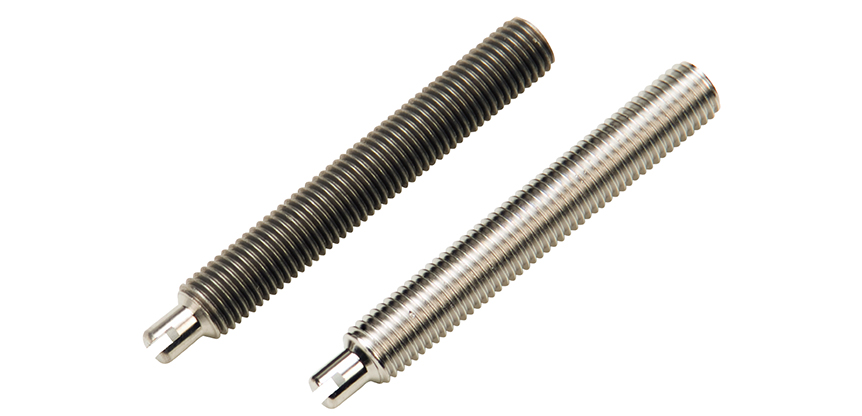
Part type: 316 stainless steel medical fastener with slotted head
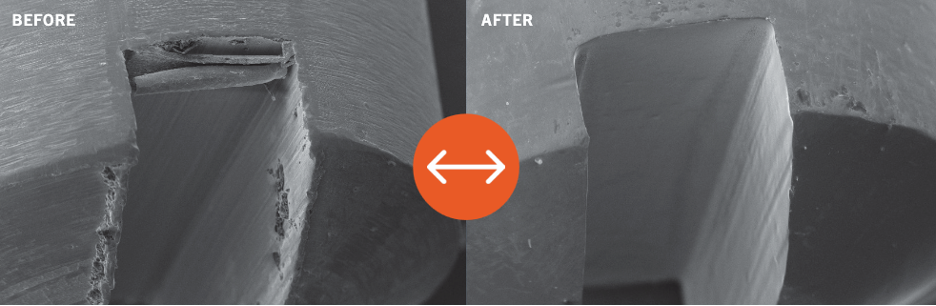
Surface defect: Large burrs in slotted head
Initial mitigation method: hand deburring
Electropolishing results:
- Consistent removal of burrs from slots
- Improved corrosion resistance
- Microfinish improvement
- Passivated part
Deburring Case Study: Electropolishing Eliminates Burrs and Tedious Hand Deburring of Slotted Medical Fastener
In one example, the manufacturer of a slotted, stainless steel medical fastener resorted to hand deburring lots of 10,000 fasteners to remove the large burrs that had formed in the slots.
Then the manufacturer tried electropolishing instead.
Electropolishing was able to consistently remove the burrs from the slot, while also leaving the part free of contamination, with improved corrosion resistance and a passivated surface––in one operation.
Learn More about Our Unmatched Expertise in Deburring
At Able Electropolishing, we are the world’s largest electropolishing specialist and our expertise has been honed in collaboration with engineers across industries.
As a pioneer of the industry with more than seven decades of experience, our metal finishing solutions help manufacturers of everything from satellites to surgical implants ensure the highest quality finish, fit and function of their metal parts.
Contact a member of our team to learn more about our solutions for burr and microburr removal for a wide variety of alloys, geometries, and applications.